23 May, 2023
I am greatly saddened to report that Charles ‘Chas’ Newby has passed away at the age
of 81.
When the
Beatles returned from Hamburg in December 1960, Stuart Sutcliffe decided to
stay in Germany. With gigs booked and missing a bass guitarist, drummer Pete
Best suggested his friend Chas Newby fill in. Chas had been a member of Pete’s
group the Black Jacks , and was now at college however, he was on holiday, and
so he agreed to play with the Beatles.
Chas first
enters the Beatles’ story in 1959 when, as a guitarist in a group called the Barmen,
he performed at the Pillar Club in ‘Lowlands,’ Haymans Green where he first
encountered George Harrison. George was playing there during what he would
later refer to as his ‘moonlighting period’ as a member of the Les Stewart Quartet.
Chas would later tell Mark Lewisohn [1] that even at that stage, 'George
could play Carl Perkins better than Carl Perkins. He was an order of magnitude
better than everyone else, and everyone recognised that'.
Chas and
another member of the Barmen, Bill Barlow were friends with Pete Best, the
three attending the Collegiate School. In
August 1959 the Casbah Club opened across the road from Lowlands in the
basement of Pete’s house. Many of the Pillar Club regulars started going to the
Casbah as well and it was here that Chas first saw the Quarry Men, then
comprising of John Lennon, Paul McCartney, George Harrison, and Ken Brown. He
was really impressed by the fact that they could all sing, and particularly how
they harmonised on numbers such as Three Cool Cats, 'which was brilliant'.
Pete’s mum Mona
('a great character, an absolutely brilliant lady' Chas remembered) gave
the Quarry Men had a residency at the Casbah from the opening night in August
1959 until early 1961, when, following a row with over their fee they stormed
out vowing never to return. In their
place came a new band, The Blackjacks, a four-piece including former Barmen
Chas Newby and Bill Barlow, former Quarry Man Ken Brown (all three on guitars)
and Pete Best on drums, with Chas doing all the singing.
Pete joined the
Beatles in August 1960 and went to Hamburg. Chas went off to college in St
Helens.
Towards the end
of the Beatles stay, George Harrison was deported for being underage. Needing a
replacement guitarist Pete suggested his friend Chas Newby from the Blackjacks.
Pete wrote to him from Hamburg and Chas replied by telegram explaining that he
was away at college but was free for two weeks over Christmas if they still needed
him. He was music mad and didn’t mind earning a bit of extra money over the
holiday.
As is well known,
following George’s departure the rest of the Beatles ended up coming home to
Liverpool in disarray except for Stuart Sutcliffe, who had decided to remain in
Hamburg with his girlfriend Astrid Kirchherr. Expecting to replace George in
Hamburg, Chas instead found himself deputising for Stuart in Liverpool over the
Christmas period.
Chas told the Liverpool
Echo in 2019 'I borrowed a bass from a guy called Tommy McGuirk, but of
course Tommy was right-handed, so I got this bass guitar and it's not as
difficult as it sounds but I just played it upside down'.
And so, Chas
Newby, who coincidentally shared a birthday with Paul McCartney, became the
Beatles’ first left-handed bass player.
'At that
time they weren’t performing their own stuff', Chas recalled, 'It was just covers. I’d no idea that they’d been writing songs for years. George
was the one I got on the best with. He was
always telling funny stories about getting deported from Germany whenever we
sat around chatting.'
Chas played
four bookings with the Beatles:
- 17 December
at the Casbah Club
- 24 December
(Christmas Eve) at the Grosvenor Ballroom, Liscard, Wirral
- 27 December,
Litherland Town Hall
- 31 December (New
Year’s Eve) at the Casbah Club
George: Allan
Williams put us in touch with a guy called Bob Wooler, a compere on the
dance-hall circuit. He tried us out one night and put an ad in the paper:
'Direct from Hamburg. The Beatles'. And we probably looked German, too; very
different from all the other groups, with our leather jackets. We looked funny
and we played differently. We went down a bomb.
Paul: We all wore black that we had
picked up in Hamburg. All the Liverpool girls were saying, 'Are you from
Germany?' or 'I saw in the paper you are from Hamburg.'
John: Suddenly
we were a wow. Mind you, 70% of the audience thought we were a German wow, but
we didn't care about that. Even in Liverpool, people didn't know we were from
Liverpool. They thought we were from Hamburg. They said, 'Christ, they speak
good English!' which we did, of course, being English.
It was
that evening that we really came out of our shell and let go. We stood there
being cheered for the first time. This was when we began to think that we were
good. Up to Hamburg we'd thought we were OK, but not good enough. It was only
back in Liverpool that we realised the difference and saw what had happened to
us while everyone else was playing Cliff Richard shit.
The above
comments from the Beatles Anthology are well known, as is a clip of John telling
a similar story in the 1963 BBC Documentary ‘The Mersey Sound’ which has been
re-used in numerous documentaries since. No doubt many fans have tried to
visualise what these gigs must have been like, particularly the Litherland Town
Hall gig, which has attained almost mythical status, but I wonder how many include
Chas Newby in their mental image of the group on stage?
It’s a
pity none of the Beatles thought to mention his part in four of the most
important gigs they ever played.
Speaking in
2012, Chas said he had no regrets about not sticking with the Beatles saying, 'to
me then it was just four gigs with a different band, music was never going to
be a living for me. All of us at that time were thinking what we were going to
do with our lives, some doing teaching, or science, or whatever. I wanted to do
chemistry. John, Paul, and George, they just wanted to be musicians.
They had
been away in Hamburg. They’d played a hell of a lot over there, so they were
very tight, very proficient, and they gave it some stick.
But I did
the four gigs and went back to my college course the week afterwards.
They were
getting £1 each per show, which was no living. I was working and having my
education paid for by Pilkington Glass. [2]
By 4 January 1961,
Chas was back at St Helens College, studying chemistry. While he remained a life-long
friend of Pete Best and his extended family he only ever met one of the other Beatles
in the flesh again after his time in the band – a random encounter in 1962: 'I was on my way home and I pulled up at
some traffic lights. There, waiting at the crossing, was George. I said hello
and asked if he needed a lift. He said he was waiting for someone and that was
that. Off I went'.
When the
Beatles finally hit the charts, he was ‘made up’ for them, explaining 'you’ve
got to understand that the chances of them making it were miniscule. From when
I left them to when Love Me Do came out was nearly two years.
The fact
that they did make it was down to Brian’s hard work, their abundant talent and
timing.'
Brian
Epstein went round every record company he could. But everything was down in
London. There were no recording studios in Liverpool, no music production
industry at all.'
By the time of
the Beatles return to Hamburg to play at the Top Ten Club in 1961, Stuart had
decided to leave the group permanently. It has been said that John Lennon asked
Chas if he wanted to continue as the Beatles’ bass player, but he chose to go
back to the college where he was studying.
After leaving
college, Chas gained a master’s degree in chemical engineering from Manchester
University. In 1971 he and Margaret moved to Alcester after getting work with
Triplex, a firm manufacturing windscreen for trains and aircraft, including RAF
Harrier jump jets and the Concorde fleet.
It was in the
Warwickshire town that they had son Steve and daughter Jacqueline. Chas worked
there until he retired in 1990. He then retrained as a maths teacher at Warwick
University, before starting his job at Droitwich High School in Worcestershire. He explained, 'I needed
something else to do and I thought being a teacher would be good. I loved every
minute of it – it was great. It was nice to be able to give something back. Some
of my colleagues had been doing it for years, so were a bit fed up, especially
when I turned up on my Harley Davidson motorbike looking like an old rocker.'
Sadly, his pupils
were more interested in 1990s groups like the Spice Girls and Take That than
their teacher’s amazing part in the story of the worlds most successful musical act.
Having
practiced music in his spare time with a charity group, the Racketts, a 2016 meeting
with Rod Davis at Bestfest in the Casbah Club led to Chas joining the reformed Quarrymen,
the band John Lennon formed that later evolved into the Beatles.
As the author
Philip Kirkland points out, this means that Chas Newby had the unique
distinction of being the only man who was a Beatle first, then later a Quarry
Man.
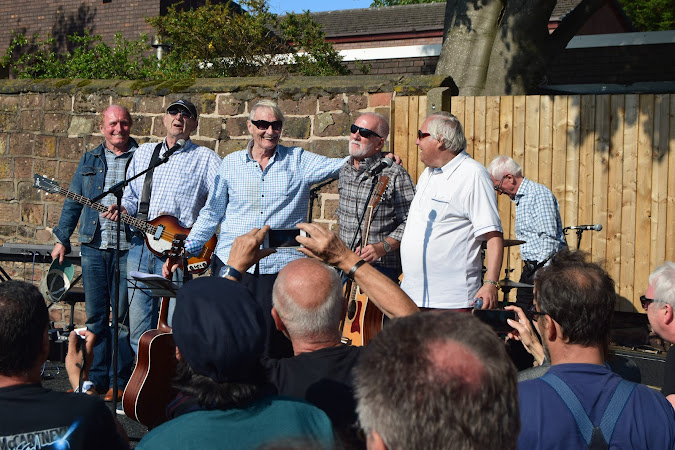
The Quarry Men at the 60th anniversary of the Woolton Village Fete in 2017 - John 'Duff' Lowe, Chas Newby, Len Garry, Rod Davis, Nigel Walley and Colin Hanton